
Money in Cuba has always been tricky, it doesn’t work the same way as home. Cuba’s currency situation has confused travelers for years, but recent changes have made things easier to understand.
I lived in Cuba from 2018-2020 and just returned again to see everything was completely different! Here’s what you need to know about bringing and exchanging money in Cuba in 2026.
Cuban Money isn’t as Complicated As You Think
Cuba uses the Cuban Peso (CUP) as its official currency. For over 20 years the country had two currencies circulating, but in January 2021 they eliminated the Convertible Peso (CUC) and unified to just the Cuban Peso.
However, economic challenges and inflation mean that US Dollars and Euros are now widely accepted alongside Cuban Pesos.
You can either exchange your foreign currency into CUP or simply use USD/EUR in many places.
First Rule: Cash is Essential
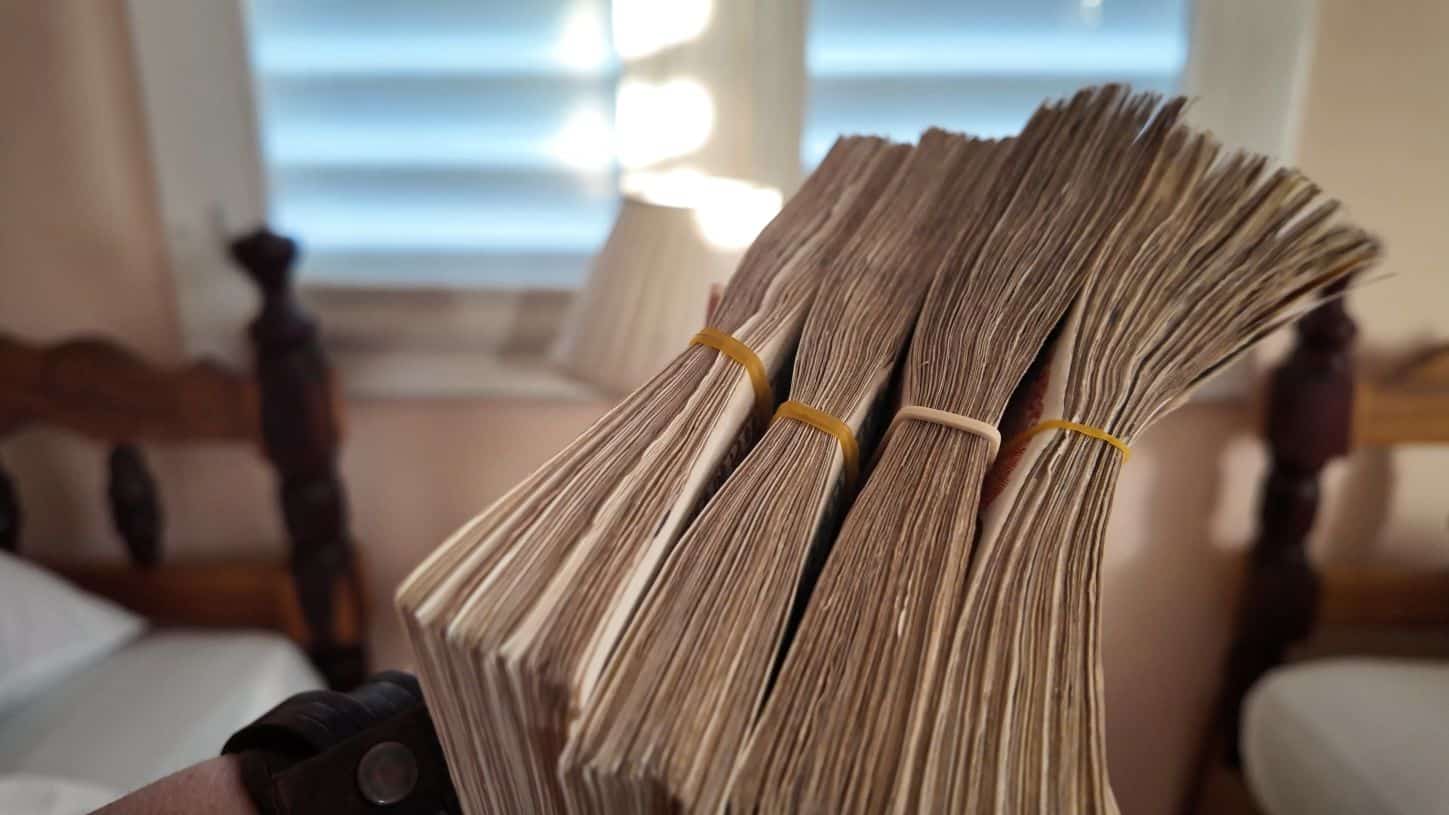
Cuba remains heavily cash-based, especially outside major hotels and tourist venues. You’ll need cash for:
- Tipping
- Private restaurants (paladares)
- Taxis
- Small shops and markets
- Local guides and services
- Most spontaneous purchases
Internet in Cuba
Credit and debit cards may work sometimes, but they’re not reliable enough to be your only payment method.
US travelers should note that US credit and debit cards generally cannot be used in Cuba, so bring sufficient cash.
Which Currency Should You Bring?
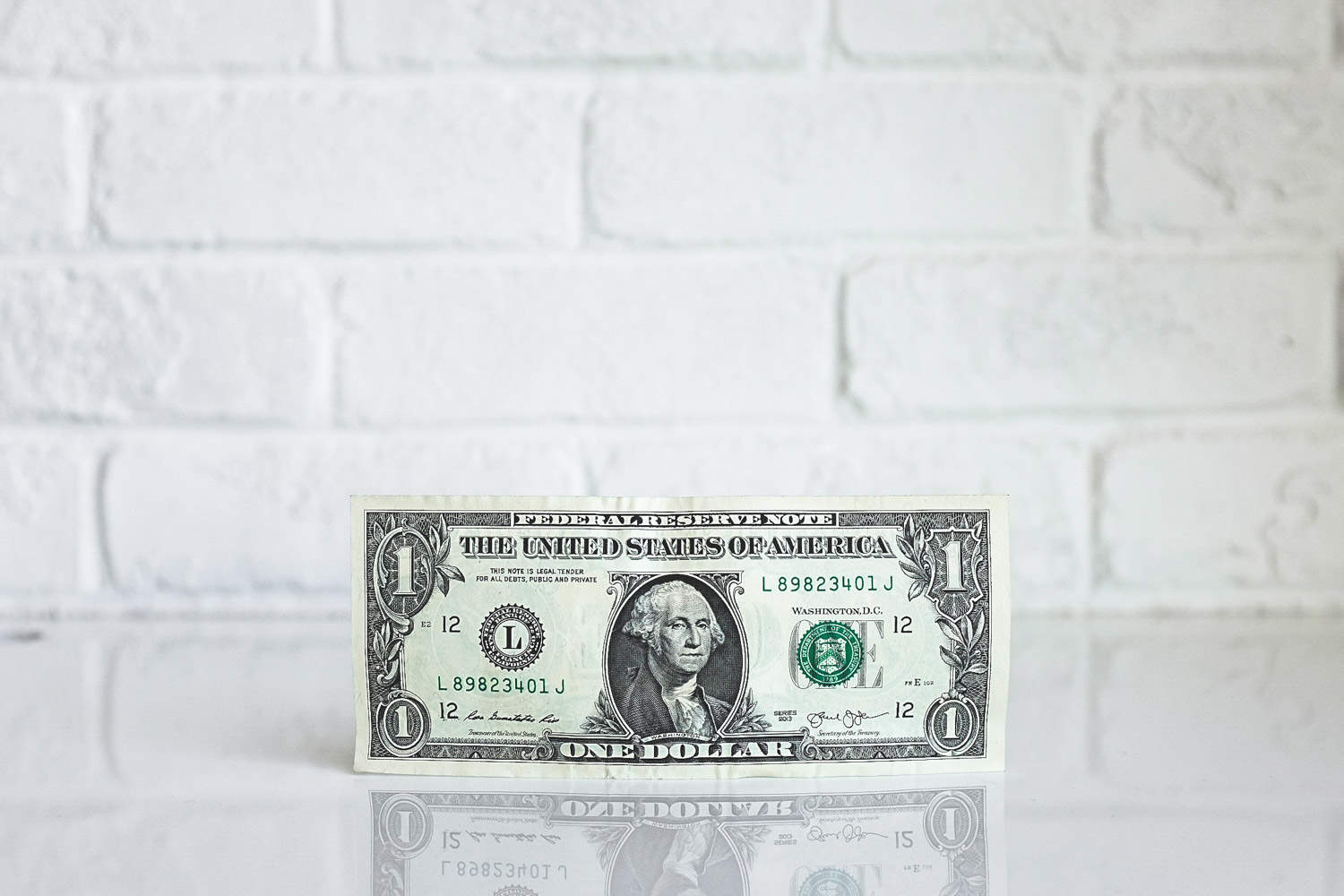
US Dollars (USD)
USD is increasingly accepted in tourism-linked businesses and is useful as a universal backup currency. Many vendors are familiar with USD pricing even when they accept payment in CUP.
I bring USD because I’m from the Americas and get the best exchange rate, though I’m Canadian.
Euros (EUR)
Euros are widely recognized and practical, especially for European travelers. The EUR exchange rate can sometimes be more favorable than USD depending on current rates.
Practical Advice
I didn’t bring Canadian Dollars on my last trip because the exchange rate was too low and they’re less valuable to Cuban workers.
Bring whichever currency gives you the best exchange rate from your home country.
Always bring small bills when possible. Shops often don’t have much change, so smaller denominations make purchases much easier.
Understanding Exchange Rates: The Government Rate
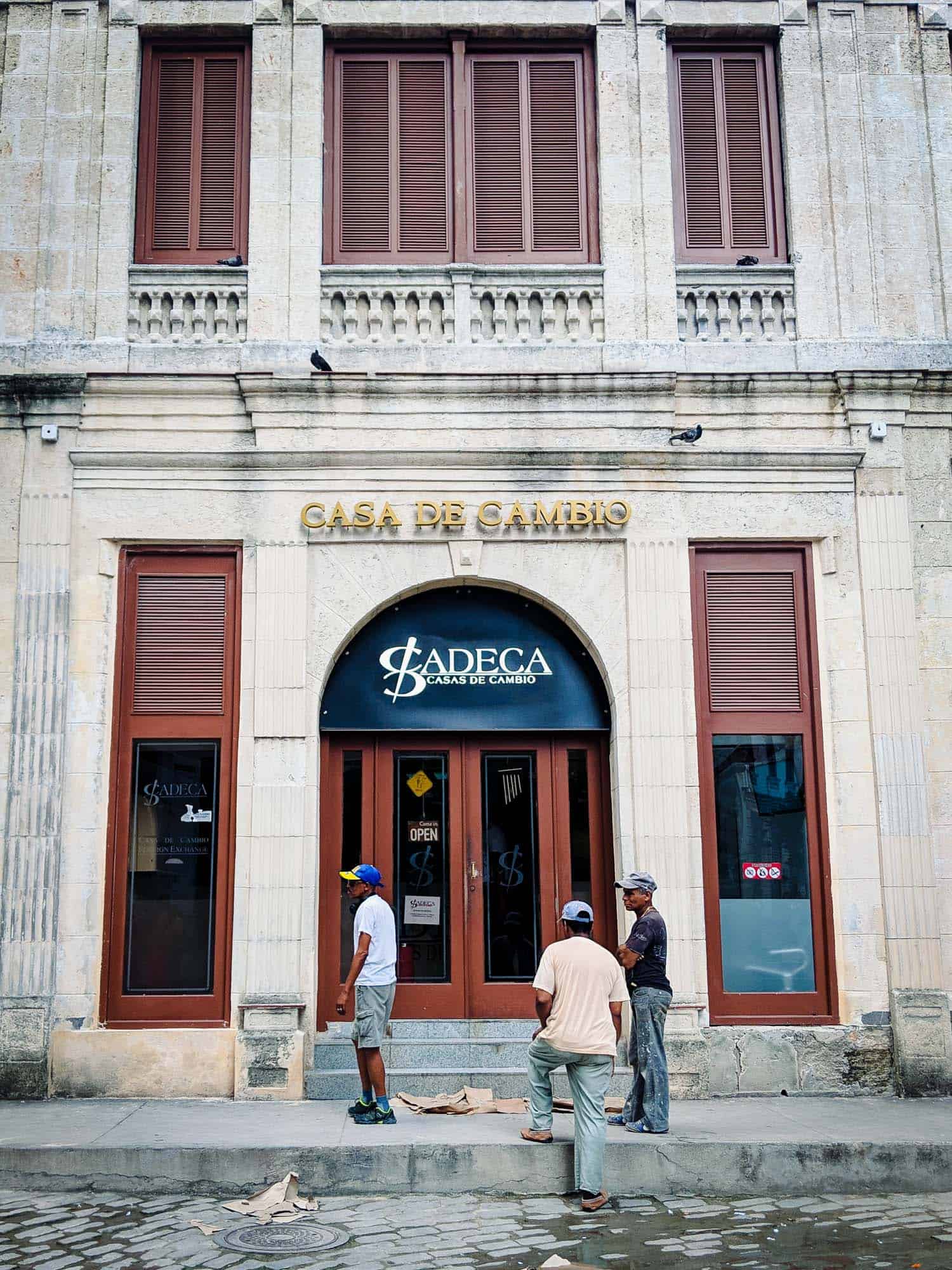
In 2025, the Cuban government set three different exchange rates to be more competitive because everyone was exchanging money on the street.
This seems very complicated to figure out 3 exchange rates.
But as a tourist you only need to pay attention to the FLOATING RATE or segment 3 below as this is for tourists who exchange money at official exchange houses.
It is meant to compete with the street rate, and it is more convenient if you don’t want to risk exchanging on your own. But it isn’t as good.
Cuba’s three official exchange rates:
1. Fixed Rate (24 CUP per USD) Used for essential goods and services like fuel, medicine, electricity and public transportation. This doesn’t affect travelers much.
2. Tourism Rate (120 CUP per USD) Applied to certain tourism sector entities and ATM withdrawals. If you use an ATM, you’ll get this rate. It’s such a bad rate only use it in emergencies.
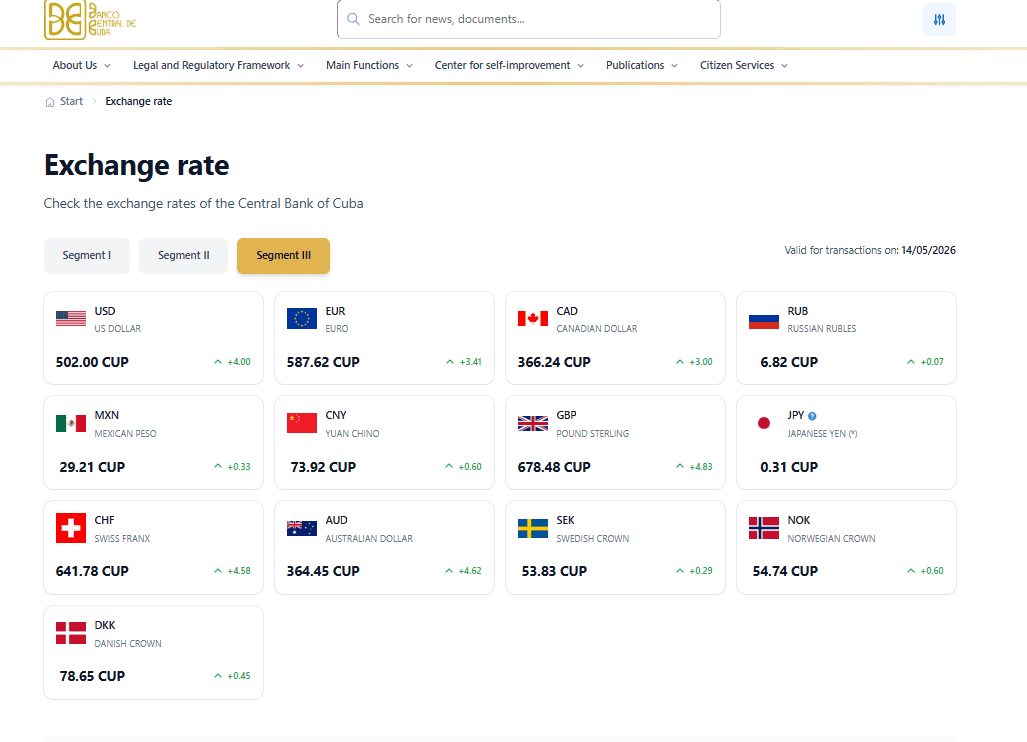
3. Floating Rate (466 CUP per USD as of January 2026) This is the new official floating rate that changes daily, published by Cuba’s Central Bank. You’ll get this rate at official currency exchange locations (CADECA).
Where to Exchange on the Official Exchange Rate
You can exchange money at banks or CADECA (government exchange houses). Check current rates at bc.gob.cu/tasas-de-cambio, which is the above screen shot. Make sure to click on segment 3 to get the floating rate for tourists.
The Informal Exchange Rate: El Toque
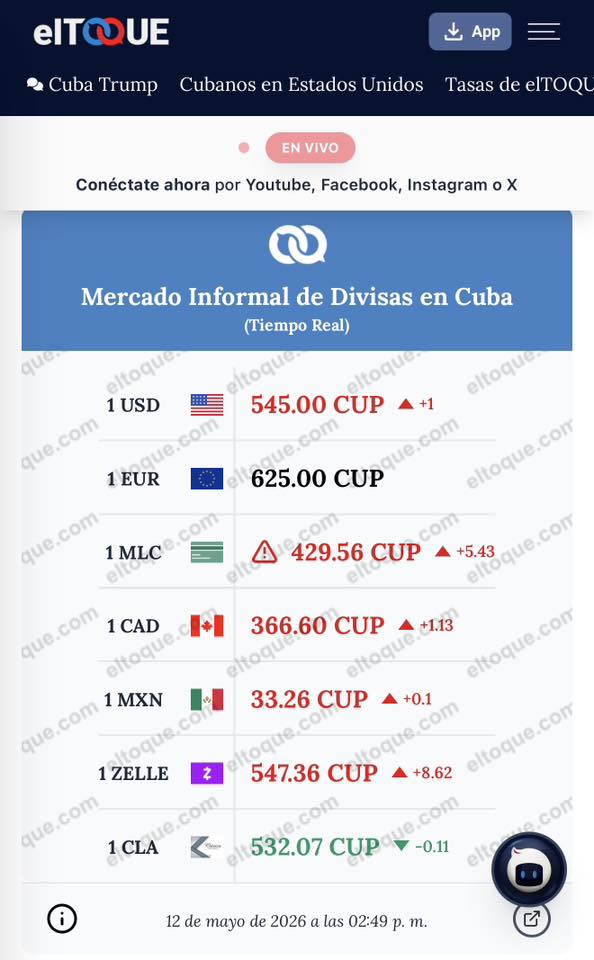
You’ll also hear about the “street rate” or “informal rate.” This isn’t as dramatic as it sounds.
For years, the government’s official rate didn’t reflect real supply and demand, so an informal market developed alongside the official one.
El Toque tracks this informal rate daily at eltoque.com/tasas-de-cambio-cuba. No one sets it. It is calculated on market demand.
Where to Exchange on “the Street” in Cuba
Never exchange money with strangers on the street. There’s too much risk of fake bills or scams. Always go through someone you trust like your casa owner, tour guide or hotel concierge.
In December my friend Osmany was able to get the exact Toque rate for me, but it’s not always possible.
Some Airbnb hosts take a small commission for the service. In regions outside Havana, rates may be slightly lower. Even if you don’t get the exact El Toque rate it’s likely to be better than the government rate,
Using ATMs in Cuba
Technically yes for non-Americans. When I lived in CUba I used my Canadian bank card to withdraw money from ATMs.
But ATMs now fall under the Segment 2, which is a really bad 120 CUP exchange rate.
This means you’re losing money compared to exchanging cash at CADECA or through trusted contacts.
If you run out of money this is a last resort for non-Americans. Not surprisingly, the banks do not take American Express.
Using Credit Cards in Cuba
Cuba is a cash-based country. Most places do not have the capacity to take credit cards. Visa is the most common, then Mastercard.
Often hotels and resorts will accept credit cards but you will need to show identification.
Instead of carrying your passport out when you travel just take a photo of it on your phone and show it when presenting identification.
Paying for Things
Always ask before ordering whether they accept CUP or foreign currency. Many places will take either. If paying in USD or EUR, ask beforehand what exchange rate they’re using. It’s often close to the El Toque rate but not always exact.
Whether you exchange through El Toque connections or the official route, you’re much better off than paying directly with foreign cash without knowing the rate.
Some Cuban food restaurants and casas particulares accept card payments (POS terminals, transfers, payment links) but it’s not common yet. Most people prefer cash because card payments require them to claim income.
Also I always take a photo of the menu I order from. It’s primarily so I remember prices for articles and videos but everyone should do this when they travel.
Unfortunately, I’ve heard recent incidents in Havana where tourists were given one menu, but then when the bill came prices were different and a mysterious new menu with increased prices were on it. Most restaurants are honest but for the few that aren’t, if they see you take a photo you’re less likely to be scammed this way.
And do not ask for a beer or fancy Cuban drinks before asking the price, especially if a new Cuban friend has brought you to the bar.
I use cash wherever possible and tip in USD since it’s most valuable to workers.


If You’re Staying at a Resort
Don’t worry about all this complexity. Just tip in dollars or euros. Canadians please know that your coins are worthless. Please tip in bills.
But if you’re traveling independently like I do, it makes a big difference. I always ask to pay in CUP. Some casas gave me better rates when I paid in dollars directly.
Money Scams
In addition to the menu scam there’s another popular one that you can easily avoid.
Always count your change in front of the person who gave it to you. When I’m with Cuban friends they always check the restaurant bill and they always count their change. About 25% of the time there is a mistake.
Make sure to check your bills and or coins to ensure that you’re getting the right Cuban currency as change.
I had a mental block when I first arrived of not wanting to offend people by counting change in front of them.
That was stupid, everyone does it.
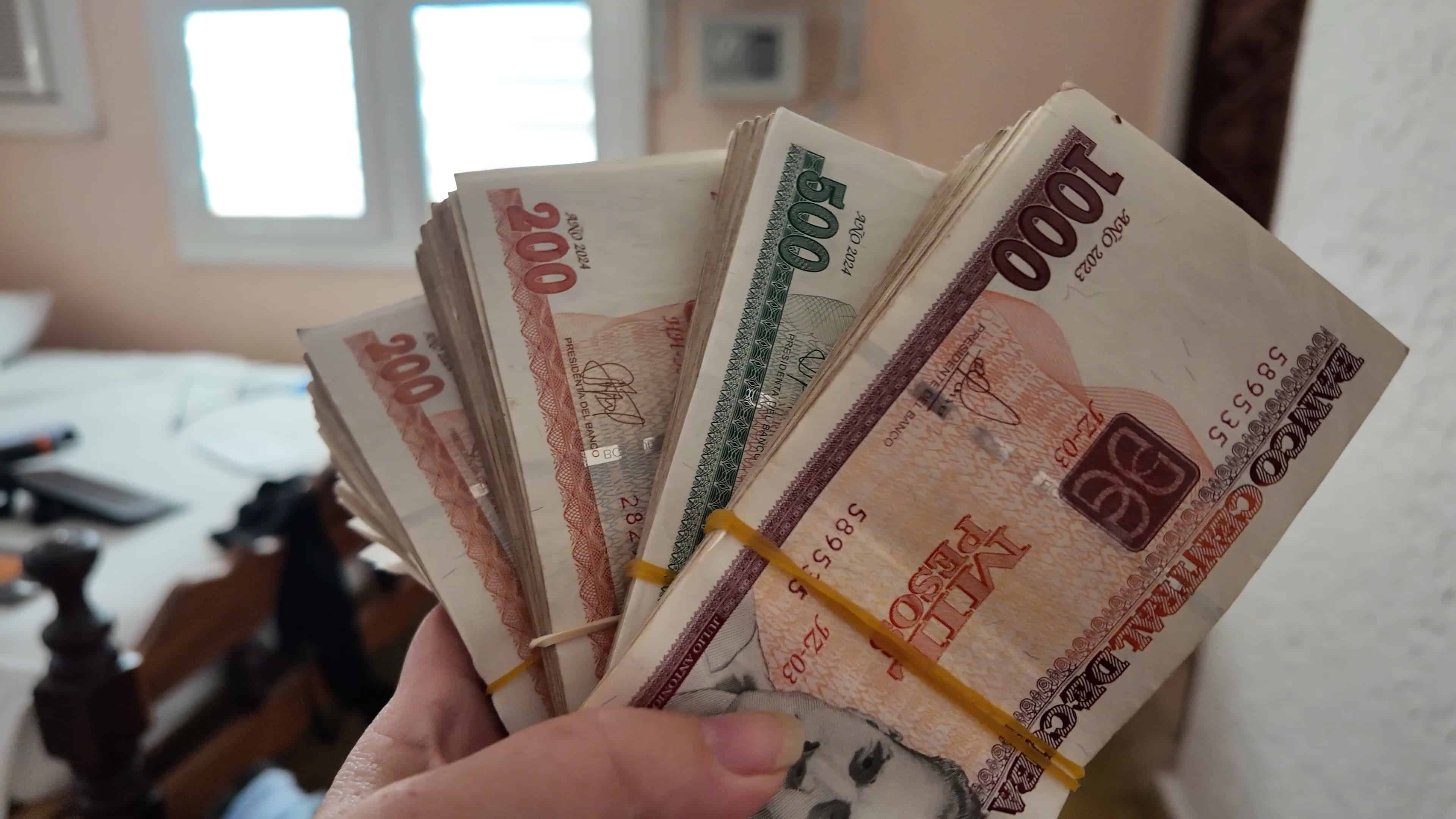
Cuban Slang Words for Money
Dinero. Moneda. Dolars. There are always a million ways to say Cuban currency. But on top of that Cuba has so many slang words for money that do not exist elsewhere.
Cuban Slang Essentials
You may also hear these Cuban slang words for Cuban currency:
- devisa one of the most common terms for CUC, the only currency
- fula but sometimes it means someone is crazy or “esta fula” so it depends on context
- plata, which means silver
- baro refers to CUP specifically
- caña refers to one CUP peso, so 10 pesos would be 10 cañas
- chavito refers to CUC specifically
- melon
- menudo refers to small change
- moni
Pin It For Later: Cuban Money
Want More Cuba Travel Tips?

Best Havana Beaches

Havana Day Trip – Las Terrazas Cuba
A Beginners Guide to Cuban Coffee

The El Capitolio Restoration

How to Spend Christmas in Cuba
Wow thank you for this detailed article! I’m planning on going to Cuba this year and will make sure to bookmark this!
Thank you for the article! Is there an app you’d recommend for the Cuban money conversion?
Well I list a bank website in the post above but I tend to use xe.com or just google the exchange rate for the Cuban peso.
So I am wondering how to change my money with locals for the 90-95 CUC per 100 USD. how can you tell if the money is counterfeit? Also, do Cubans not have to pay the 10% tax on USD? How can they afford to give a better exchange rate if they cannot use the USD?
There is definitely counterfeit money in Cuba and you probably wouldn’t be able to tell the difference. The safest person to exchange money is with is your AirBNB/Casa Particular host because they would not want a bad review.
Cubans also have to pay the tax, but there is a black market where Cubans go to Panama to buy clothing and goods – and Panama uses the USD. So they can afford to give you a better rate because they aren’t going to change it back to CUC – they will use it in Panama.
At one point people would say never bring usd to Cuba (I’m canadian), but now people are saying they are trying to phase out the cuc and use more usd to buy large appliances, etc. Have you heard if it’s better to bring usd now? Just wondering if I should have some one dollar bills to use for tips and things, I’ve heard lots of resorts in varadero have no small cuc anymore. Thanks for any info:)
Indeed there have been a lot of rumours lately. Let me break it down for you as it depends on how you travel. On resort or off resort.
ON RESORT
It’s not a bad idea. The exchange rate from 1 CAD to 1 USD is about the same as 1 CAD to 1 CUC. So you’re either exchanging at home in Canada or while you’re there in Cuba.
I have not heard of a shortage of small CUC in Varadero resorts. I follow a few Varadero resorts groups on Facebook and no one has reported an issue. It is certainly not a shortage off the resorts. The resorts know tourists need small CUC for tips for their workers. Resort workers make the most money in Cuba so if they didn’t have access to tips you can bet they would be complaining.
It really depends on whether or not you want to pay to exchange from CAD to USD. It doesn’t hurt to have USD when you travel anywhere. I always keep $100 on me with my passport just in case. But to get $1 bills you’d need to call your bank and ask for them in advance if you’re not in a major city.
You can tip in Canadian dollars, although it would need to be $5+, no loonies or toonies. Cubans go to the bank or Cadeca (currency house) and exchange foreign currency. They will not turn down a tip in any currency because it can be easily exchanged.
I don’t know if you plan to go into town, it’s perfectly safe as the town was created for tourism and is just full of things for people to do once they grow tired of the beach. But you can use your bank card there (if it’s one that I listed) AND they would also be able to give you change at restaurants/bars/shops.
OFF RESORT
The official bank exchange for USD is ALWAYS 1 CUC is .87 cents. However, the “street” value has always been higher because Cubans have always used USD. And so some travelers who stay at Airbnbs bring USD and the owners would give them up to .95 cents. It’s good because Cubans get a good deal on USD and Americans don’t have to pay to convert their USDs to Canadian or Euro and then again to CUC.
So many Cubans go to Panama (which uses USD) to buy clothing and electronics to sell on the black market here. USD has always existed but it’s not something tourists were aware of but part of life here.
Late 2019 there were rumours that the CUC was leaving. And the appliance stores opened where you could use USD but you had to have a bank account to pay for things – many Cubans don’t keep a bank account for various reasons from not having enough money to put in the bank to not wanting the government to know how much money they have.
This fuelled more speculation that the CUC was finally leaving, a promise that was made long ago to end the dual currencies as they weren’t necessary. People who had money stored away at home in CUC wanted to exchange to USD which created a shortage of supply. And so in November you could get 1.20 CUC for 1 USD. That lasted a couple weeks. And now it’s usually 1-1 with casa owners.
If you’re on Cuba Facebook groups or chatrooms you’ll probably hear a lot of talk about the best currency to bring and that is likely from Americans who are not staying on resorts because they don’t want to exchange if they don’t have to. They also can’t get more money out if they need it which creates even more stress.
Hope this helps!
Less. Less milk, less stoves, less recycling, less choices and less freedom…. thanks for reminding me, how fortunate I am to live here in America, in a capitalist economy, and in a free society. Because economics, & the ability to make a good living along with the freedom to have choices, options and as great a life as I can make it, has never, ever come through Communism or Socialism. Now, in America, it is an especially great time, as we throw off the chains of over-regulation, which has inhibited individual businesses & job growth, and is caused by too much government interference. Because the more a government interferes in your life, the more it limits your freedom and choices, and the worse your life gets.
There are pros and cons to every country. Being in Cuba I do see some advantages particularly with education. And of course as a Canadian I recognize the value of free healthcare. Many tourists don’t see how the independent economy really works because they spend little time there. There is much to improve but also much I really respect.
I love that Canada is a socialist country but we are far from perfect. No country is.
Hello I am traveling to Cuba and our lay over is in Panama. Is it possible to exchange USD to Panamian money and then the Panamian money to CUC or CUP? Does cuba exchange panamian money? Thank you!
Panama actually uses the US Dollar as their currency, as do some other countries like Ecuador, El Salvador and many others.
If you are staying at an Airbnb you can ask your owner if they would exchange USD for CUC. Many Cubans want USD as they travel to Panama to buy goods for the black market. You can probably get a 1-1 exchange.
If not the Cadeca (money exchange house) and banks offer .87 cents for one American dollar. This conversion rate never changes.
Hi Ayngelina
Thanks for your great article! It’s by far the most useful that I’ve read so far!
I’m traveling to Cuba in a couple of weeks and I’m still figuring out how am I going to tip.
It’s ok to tip with CUPs? I was planning to tip with GBP or EUR, but they don’t accept coins and the lowest notes for those currencies are £5 and 5€, I can’t tip everyone with that amount 🙁
Also I heard that it’s still fine to tip with USD, so I was planning to tip with 1$ or CUPs, do you know if that’s ok for them?
Many many many thanks!
Yes it’s fine to tip in USD. However if you’re going off the resort and want to pay for things you should pay in CUP. And always ask what currency your menu is in. There have been several reports of people who wanted to pay in Euro or USD and the exchange rate wasn’t the official one and it became very pricey.